


Foreword
In 2025, the postal ombudsman received 4,390 requests for mediation, of which 2,367 admissible cases were investigated in depth.
The number of cases handled increased by 14% compared to 2024. This increase is largely due to the rise in complaints relating to the non-delivery or late delivery of daily newspapers. This development is part of the gradual transfer of newspaper distribution from bpost to other distributors, a transition that is not without consequences for readers.
In the parcel transport sector, on the other hand, we have seen a slight decrease in complaints, even though e-commerce continued to grow in 2025. Overall, the sector seems to be successfully absorbing the increase in parcel volume – particularly C2C shipments between individuals – and adapting its logistics flows to ever-higher expectations and new consumer habits.
However, behind this positive trend, the complaints received also reveal certain structural weaknesses in the transport of goods: lack of proof for the sender or recipient in the event of loss or damage, sometimes insecure distribution methods, untraceable shipments, insufficient proof of delivery or opaque return procedures.
Furthermore, complaints related to e-commerce parcels continue to increase. That is why this annual report devotes a specific chapter to this issue, at the intersection of postal law and consumer law. All too often, consumers find themselves caught between online shops, platforms and carriers, each of which passes the buck to the other. We call on parcel delivery companies and online retailers operating in Belgium to enter into clear agreements that are genuinely consumer-oriented.
Beyond the figures, this annual report provides a concrete overview of the difficulties encountered by citizens and businesses in their dealings with postal operators. Behind each case lies a disappointed expectation, a lost shipment, a misunderstood process or a practice deemed unfair. In these situations, the mediator acts as an impartial third party, responsible for re-establishing dialogue and seeking a fair solution. For the companies concerned, mediation also represents a valuable opportunity: that of resolving a conflict and restoring customer confidence.
The most frequent and significant disputes have been translated into three structural recommendations addressed to the sector, as well as an appeal to the authorities formulated as part of the revision of the European Postal Directive.
In individual cases, mediation is bearing fruit: 87% of cases are settled amicably. This can take various forms: measures to improve the security of future shipments, compensation for the damage suffered, receipt of a shipment that has finally been found, or the issuance of a certificate of non-receipt allowing the consumer to assert their rights with an online shop.
In many cases, however, there is no decisive evidence to clearly settle between the conflicting versions of the parties involved. The mediator's role is then to seek a solution that is acceptable to both parties on the basis of the available evidence. As one of the complainants puts it:
‘Although we do not entirely agree with the postal company’s reasoning and limitation of liability, we accept the compensation offered in the spirit of continuity and in positive anticipation of future deliveries.’
These results are the fruit of the labour of a skilled and dedicated team that is deeply committed to providing high-quality service to citizens. The past year also saw the well-deserved retirement of two colleagues and the arrival of an enthusiastic new member to strengthen our team.
We invite you to read this annual report, which reflects both the challenges facing the postal sector and the concrete solutions provided on a daily basis by mediation.

OMBUDSMAN POSTE IN 2025

2025 at a glance

Overview of the parties
Plaintiffs
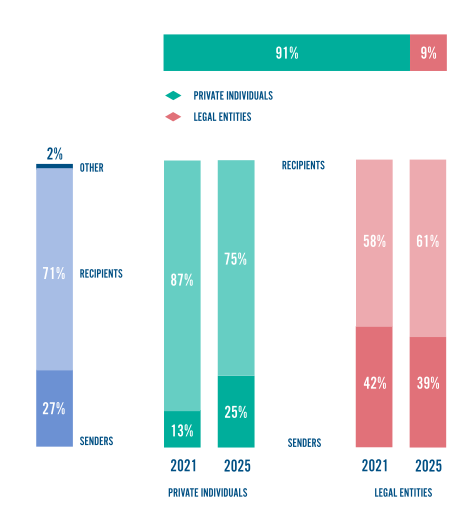
91% of applicants are private individuals. Legal entities therefore account for 9%. In the latter category, the ombudsman service mainly mediates for the self-employed, liberal professions and SMEs. Associations and government agencies also turn to ombudsman poste.
Large customers have a tailor-made contract as the sender and a contact person within the parcel company who maintains the contractual relationship.
Both private individuals and legal entities mainly submit complaints as recipients of a shipment.
Method of registration
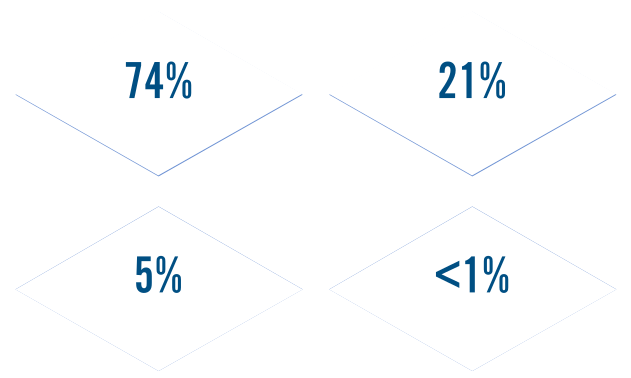
Mediation requests are submitted via the complaint form on the ombudsmanposte.be website (55%) or by email (41%). Thirty complaints were submitted by postal letter and eight people explained their dispute in person at the offices of ombudsman poste.
In 97% of cases, the customer contacts the ombudsman service directly. 72 cases were referred by the Consumer Ombudsman Service, 61 by another ombudsman and 7 by Belmed. Mediation requests can only be submitted in writing.
To ensure that our services are accessible, people can call us to request information. During a telephone conversation, the caller can explain their situation . We provide information about how the sector works, the rights of postal users and the steps required to submit a complaint, both for the first and second-line procedures.
Postal companies
The Ombudsman Service for the Postal Sector operates in line with the European and national objective of resolving disputes through consensus. Users of postal and parcel services may submit a request for mediation.
Since February 2007, as a direct result of the liberalization of the postal sector, the Ombudsman has extended its responsibilities to all companies that transport mail and parcels and are active on the Belgian postal market. In each case, ombudsman poste strives to reach an amicable agreement between the parties. The ombudsman mediates on the basis of the parties' positions, the applicable regulations and fairness.
ombudsman poste invests heavily in cooperation with postal companies to maximise the chances of reaching an amicable solution in each case. To that end, the ombudsman holds a personal case meeting with bpost every six weeks. These meetings discuss cases where an amicable solution has not been reached in the regular mediation procedure.
From 2021, similar structured consultations were also started with UPS, DPD, GLS, Fedex and PostNL, followed by Mondial Relay and Colis Privé in 2023. Ad hoc meetings are held with the other companies to discuss cases and thus maximise the chances of reaching an amicable solution.
Mediation requests

Admissible requests
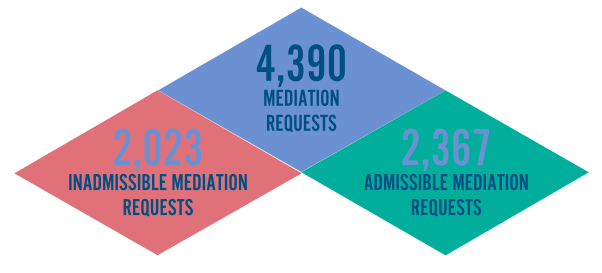
ombudsman poste mediates in individual disputes between postal users on the one hand and postal and parcel companies on the other. The ultimate goal is to reach an amicable agreement between the customer and the company. In 2025, 4,390 mediation requests were submitted to the ombudsman service. 2,367 of these cases were declared admissible.
Each new request is first analysed to determine whether it falls within the ombudsman's remit. In addition, the ombudsman service examines whether the request meets a number of conditions laid down by law, known as the admissibility test.
Inadmissible requests
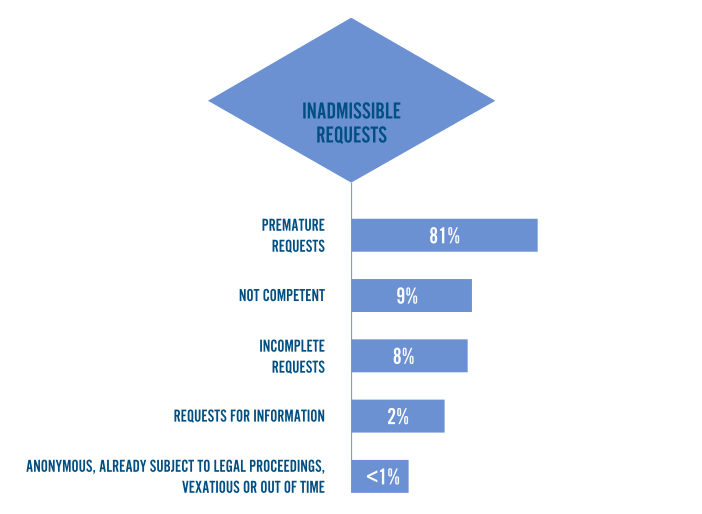
In 2025, 2,023 mediation requests were declared inadmissible. By far the most important reason why requests are inadmissible are due to the fact that they have not yet been submitted to the company itself (premature complaints).
As an appeals body, the ombudsman service can only investigate once the postal company has had the opportunity to resolve the dispute in accordance with its internal customer and complaints procedures. ombudsman poste forwards the inadmissible complaint to the postal company with a request for a first-line investigation. If the customer does not receive a response from the company or is not satisfied with the solution provided, they can appeal to the ombudsman.
The ombudsman service forwards inadmissible complaints to the customer service department of the company concerned for follow-up. This is in accordance with its legal mandate.

Trends 2015–2025
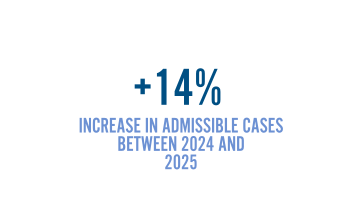
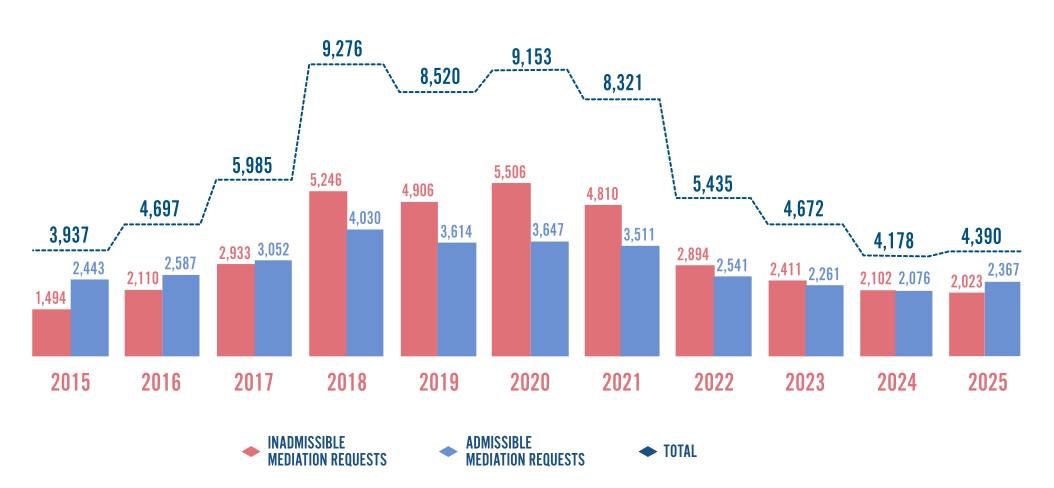
4,390 disputes were submitted in 2025. This represents a slight increase of 5% in the number of mediation requests compared to 2024. The number of cases in which the ombudsman service has actually initiated an investigation and mediation (= admissible cases) has increased by 14%.
Since the service was launched in 1993, the number of mediation requests has risen gradually until 2003. From 2004 onwards, we have seen a steady increase in the number of professional disputes year after year, driven by a growing parcel sector. The increase peaked at around 9,000 requests in 2018, 2019 and 2020. The high number of disputes in 2020 was also due to the COVID-19 pandemic, which gave e-commerce and, consequently, parcel transport a strong boost. 2022 was characterised by a sharp decline in the number of new mediation requests. In 2023 and 2024, the number of requests continued to fall. In 2025, there was a slight increase in the number of mediation requests, mainly due to problems in newspaper distribution.
We do not have a conclusive explanation for the decline in the number of disputes submitted in recent years. The following factors play a role in this evolution:
- a decline in the number of complaints about letter post in a declining letter market
- a sharp decline in customs-related disputes for international parcels.
- the first point of contact for consumers who encounter a problem with the delivery of their online purchase is the webshop.
- consumers are not aware that they can (also) request an investigation from the postal company (and appeal to ombudsman poste) or are referred to the webshop by the postal company itself.
- e-commerce or second-hand purchases with a low purchase value. In communications with consumers, it appears that for some citizens, initiating an ombudsman procedure requires too much effort in relation to the limited loss.
- postal companies have responded effectively to the strong growth in e-commerce parcel delivery, adapting their processes to handle the increased volume efficiently.
- The Ombudsman Service for the Postal Sector is not sufficiently visible. This is a recurring comment in a satisfaction survey that the plaintiff receives after their case has been closed.
Most plaintiffs to the Ombudsman Service are recipients. These recipients do not receive invoices that include the details of the sectoral Ombudsman Service, as required by the regulations. They therefore have to find an appeals body for complaints themselves.
To that end, we are discussing with the parcel companies the possibility of displaying the ombudsman service's details prominently on relevant web pages, rather than hiding them at the end of a page-long document on the General Terms and Conditions.
Complaints

From mediation requests to complaints
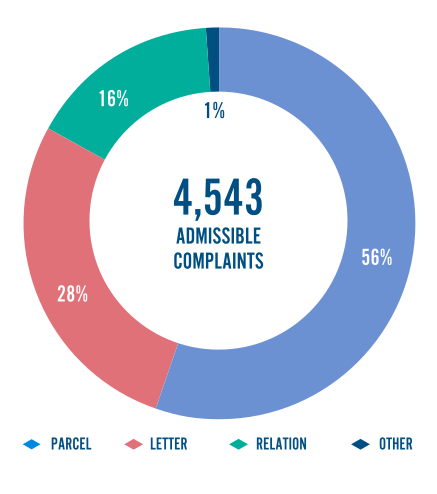
4,543 admissible complaints
The Ombudsman codes each request for mediation on the basis of a European CEN standard. Each mediation request can be assigned different complaints, based on the customer's description of the dispute. The added value of this way of working is that it provides a detailed picture of the problems people experience when sending and receiving parcels and letters. This information also shows the sector and individual companies opportunities to increase customer satisfaction.
2,367 mediation requests were declared admissible and investigated in 2025. These 2,367 unique mediation requests incorporated 4,543 complaints, an average of 1.9 complaints per case.
Since 2017, the number of mediation requests concerning letter post has been declining as a result of a shrinking letter market. However, for 2025, we are again seeing an increase in letter post complaints. This is entirely due to problems following the transfer of newspaper distribution from bpost to other market players.
Complaints by postal segment
OMBUDSMAN FILE

COMPLAINT
'The postal company failed to deliver my shipment with reference ... The parcel has been lost. The contents were baby clothes and baby items, a breast pump, baby bibs, bibs, maternity pads that were purchased as a gift - see video. There is no invoice for this purchase, only a proof of payment, which has already been delivered.Despite the proof of value I provided, the postal service refuses to pay proper compensation and states that only an invoice will be accepted. This is unacceptable to me, as the loss is entirely due to the transport company and I am being financially disadvantaged by a mistake for which I am not responsible.

1 file – 2 complaints
The above mediation request contains 2 complaints: a missing parcel and a claim for compensation
Complaints per company
| Parcels | Letter post | Customer relationship | Other services | TOTAL | |
|---|---|---|---|---|---|
| bpost | 1.676 | 722 | 479 | 27 | 2.904 |
| AMP | - | 440 | 19 | - | 459 |
| DPD | 188 | - | 87 | - | 275 |
| Colis Privé | 148 | - | 40 | - | 188 |
| PostNL | 147 | - | 36 | - | 183 |
| UPS | 137 | - | 25 | - | 162 |
| GLS | 67 | - | 15 | - | 82 |
| Mondial Relay | 67 | - | 12 | - | 79 |
| PPP | - | 52 | 3 | - | 55 |
| Fedex | 45 | - | 5 | - | 50 |
| BD Media | - | 38 | 2 | - | 40 |
| DHL express | 20 | - | 2 | - | 22 |
| Vinted Go | 11 | - | 3 | - | 14 |
| Direct Presse | - | 10 | 1 | - | 11 |
| DHL ecommerce | 7 | - | 2 | - | 9 |
| Amazon Logistics | 4 | - | - | - | 4 |
| Dynalogic | 4 | - | - | - | 4 |
| Belgium Parcels Service | 2 | - | - | - | 2 |
| Total | 2,523 | 1,262 | 731 | 27 | 4,543 |
Most ombudsman complaints concern bpost, but bpost's share of the total number of complaints has been declining in recent years.
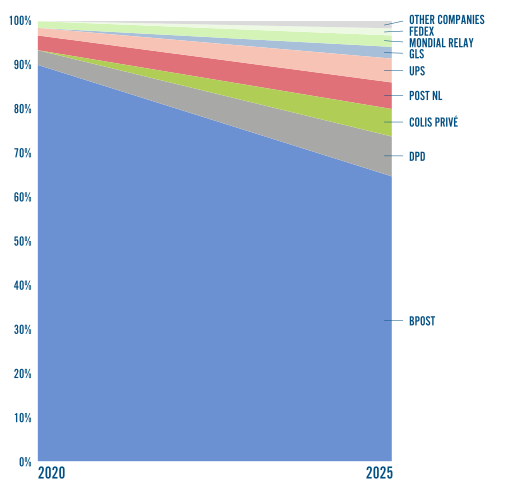
This decline will continue strongly in 2025, with 64% of complaints attributable to bpost, compared to 78% in 2024. One explanation for this is the declining volume of the letter market. This also results in a decrease in the number of professional complaints submitted to the ombudsman service, despite the fact that a number of letter mail products remain important to citizens. However, in the parcel sector too, we see a more differentiated picture in the share of the various parcel companies in the ombudsman complaints. Bpost's share of parcel complaints will be 67% in 2025 (72% in 2024, 74% in 2023 and 82% in 2022).
The other parcel companies account for 33% of all complaints about parcels to ombudsman poste. UPS and DPD show a sharp increase in the number of complaints compared to 2024, and the number of complaints against Colis Privé also continues to rise in 2025. PostNL, Mondial Relay and Fedex show a decrease in the number of ombudsman complaints.
The figure below shows the increasing diversification of ombudsman complaints about parcels between 2020 and 2025 across the various players in the market.
Finally, 2025 shows a strikingly high number of complaints about newspapers. The transfer of newspaper distribution from bpost to other players in the market began at the end of 2024. In 2025, several regions in Flanders as well as one area in Wallonia were transferred to private players. The switchover was accompanied by newspapers not being delivered or being delivered late to subscribers' letterboxes. The ombudsman service received 565 complaints in 2025, compared to 44 complaints about newspaper distribution in 2023 and 67 complaints in 2024. This is a remarkable increase, especially considering that the transfer of newspaper distribution from bpost to the new operators has only been completed for a limited part of the country.
Parcels

42%
OF COMPLAINTS ABOUT PARCELS ARE RELATED TO DOMESTIC SHIPMENTS

30%
ARE RELATED TO PARCELS SHIPPED WITHIN THE EUROPEAN UNION

28%
ARE RELATED TO SHIPMENTS TO OR FROM COUNTRIES OUTSIDE THE EUROPEAN UNION
In 2025, most complaints will continue to concern domestic goods transport.
The trend of Belgians increasingly making online purchases within and outside Europe is also evident in the ombudsman complaints. The number of disputes concerning goods transported between Belgium and countries outside the European Union amounts to 27% (compared to 28% in 2024). These complaints relate almost exclusively to inbound parcels, mainly from China, but also from the United States and Great Britain. This percentage is an underestimation of the number of complaints relating to parcels coming from China. In handling the complaints, it is noticeable that many Chinese parcels are relabelled in Belgium or another European country.
The relationship between sender and recipient is as follows:
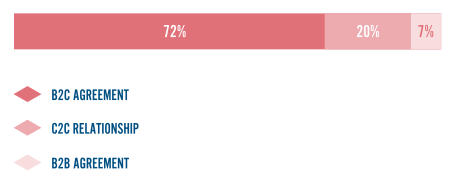
The C2C category mainly concerns an increasing number of mediation requests relating to second-hand sales.
Complaint themes
| PARCELS 2025 | Transport | Customs clearance | Total |
|---|---|---|---|
| Lost parcels | 790 | 18 | 808 |
| Compensation | 464 | 58 | 522 |
| Error in delivery | 380 | - | 380 |
| Delay | 150 | 62 | 212 |
| tariffs/costs/invoicing | 19 | 178 | 197 |
| unjustified return | 115 | 28 | 143 |
| Damaged | 108 | - | 108 |
| Tracking | 85 | 2 | 87 |
| Other | 53 | 13 | 66 |
| Total | 2.164 | 359 | 2.523 |
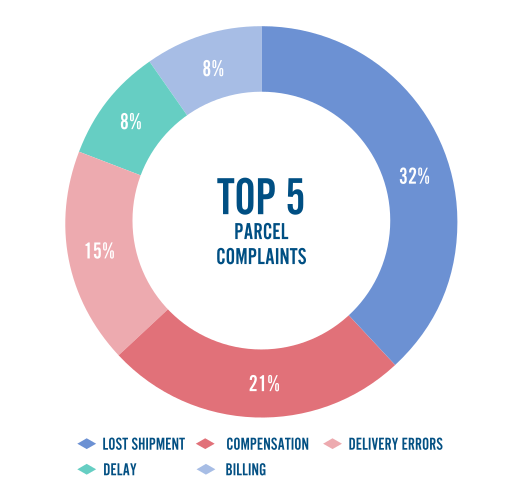
A lost parcel remains the number one complaint. In addition, we note an increase in the number of complaints about delays in the postal system in 2025. Complaints about the customs clearance of non-European inbound parcels continue to decline year after year following the boom in 2021. In 2025, we notice that 359 complaints about customs clearance, mainly relating to the customs clearance costs that recipients have to pay.
Lost parcels
My parcel has been lost. This is and remains the most common complaint submitted to the ombudsman service by senders and recipients. We record a significant proportion of complaints about lost parcels for each postal company. After investigation, some of these disputes are resolved by finding the shipment: at a neighbour's house, in a sorting centre, at a delivery office, at a collection point, at the undeliverable mail service, etc. However, in many cases, the end result is that a shipment remains untraceable.
The high number of complaints about disappearances is remarkable, given the sector's investment in extensive scanning systems, geolocation, weighing and recording in sorting centres, etc.
Analysis of the ombudsman's complaints points to three practices within the sector that increase the risk of a parcel being lost:
- Parcels left unattended in an insecure location
- Immediate disappearance of parcels after drop-off
- Untraceable parcels
Parcels left unattended in an insecure location
When ordering goods online, the buyer is usually given the option of choosing how they want to receive their parcel: at a specific address, in a parcel locker or at a collection point. The increasing number of parcel lockers is striking in the streetscape. However, many citizens still prefer to receive their parcels at their home address rather than an alternative delivery point.
And the pressure on postmen, drivers and couriers to ensure that the parcel is delivered on the first attempt is high. Promises made by the web giants for next or same day delivery, Sunday delivery, etc. must be fulfilled by the delivery agent in a competitive postal and parcel sector.
When residents are not at home at the time of delivery, many parcels are left at the recipient's address on the initiative of the delivery person. The recipient claims not to have found the parcel upon their return home, but did receive a notification (in the letterbox, by email, in the app) that the parcel was successfully delivered. The tracking also shows the status 'delivered'.
OMBUDSMAN FILE
COMPLAINT
A woman regularly orders goods from a webshop in China. She notices that the parcels are always left at her front door when no one is home. Most of the parcels were still there, but she could not find three of them. She reported this to the webshop each time and was promptly refunded for the first two purchases. When she reported the third one, the webshop refused to reimburse her because the driver had delivered to the correct address. The lady then lodged a complaint with the courier company, but after a few days she received a reply stating that her complaint had been closed, without any explanation. During the ombudsman's investigation, it was demonstrated that the parcels had indeed been left behind each time, contrary to the courier company's procedures. The courier company informed the sender that they would take responsibility for the loss.
SOLUTION
The lady receives a replacement shipment from the webshop. The postal company reimburses the sender and takes measures to ensure correct delivery in future.
This practice leads to many complaints to the ombudsman service about missing parcels. In the above example, the customer was correctly reimbursed by the sender. In many cases, however, we see no solution for the recipient because he cannot prove to the sender that he did not actually find his goods when he returned home.
The ombudsman has formulated a recommendation to the sector regarding unattended parcels.
Immediate disappearance of parcels after drop-off
Senders who suffer damage because their parcel disappears after delivery: this is a relatively new problem where the ombudsman is called upon to find a settlement between the parties. In 2025, there were 62 cases, and in 2024 there were 54 cases, all against bpost.
Although the number of complaints is limited, the ombudsman service considers bpost's liability in these disputes to be higher than specified in their general terms and conditions.
When the parcel is delivered, the sender receives a proof of delivery and/or the tracking system indicates that the parcel has been accepted into the postal circuit. After that, there is no further scanning, as the parcel has not reached the sorting centre. Even after investigation, the parcel remains untraceable.
There are various methods of delivery: in a locker, at a postal point or at a post office. The parcels concern both outgoing and return shipments and, as a result, the victims are professional senders, private senders in the context of second-hand sales and consumers returning their purchases. The limitation of liability in the sector and in the universal postal service means that senders receive no or very limited compensation. In cases where consumers wish to return their purchases, we see that the webshop refuses to allow a refund despite the fact that the consumer can provide proof of return.
It is bpost's job to transport parcels delivered to them to their intended destination. Customers are rightfully frustrated when their parcel disappears without a trace after they have handed it over to bpost for which the operator is unable to provide any satisfactory explanation. The limited compensation provided does not compensate for the postal company's negligence in these situations. If we cannot reach an amicable agreement between the plaintiff and bpost in these cases, the ombudsman will take a position in favour of the plaintiff and make an individual recommendation to the postal company to compensate the customer for the full amount of the damage.

Untraceable parcels: no investigation in case of problems, no compensation
Untraceable shipments are international economy parcels exchanged between universal service providers, bpost in Belgium. The Universal Postal Union Convention (international postal agreements) applies. These shipments are untraceable or very limited (only upon delivery and/or customs clearance). An investigation into parcels with a tracking number that cannot be followed up is also very limited or non-existent and leads directly to the shipment being declared lost, without compensation for the sender or recipient.
The lack of tracking is no longer in line with the reasonable expectations of users in a digital market. A standard obligation to track every parcel would increase transparency, legal certainty and confidence in cross-border purchases. A parcel that disappears in the postal network without leaving a trace. Postal users and the ombudsman do not understand this in a digital age with advanced technical capabilities for scanning, tracking, image recording, automated weight registration, etc. Nor do users understand that they cannot claim compensation for the loss of a shipment during transport. This leads to professional complaints to the ombudsman.
OMBUDSMAN FILE
COMPLAINT
A woman orders an XL photo. When she gets home, she finds a note in her letterbox saying that she can collect her parcel from a postal point where the package is not to be found. Customer service informs her that the sender opted for a non-traceable shipping method and therefore no investigation or compensation is possible. The woman is not satisfied with this.
SOLUTION
The ombudsman service's investigation is limited as the parcel cannot be traced. The parcel is not found at the undeliverable items service, nor after a second enquiry at the postal point. The ombudsman service informs the customer that further investigation by the postal company is indeed not possible and recommends that she contact the sender who chose this shipping method.
In the context of the preparations for a new European Postal Directive, the ombudsman service writes a recommendation to exclude untraceable shipments in the sector.
Claim for compensation
Compensation is awarded to the sender, and the sector has a limitation of liability for that sender: the value of the goods is not automatically reimbursed in the event of loss or damage.
Citizens and start-ups are often unaware of this and react angrily when it turns out that they will not be (fully) reimbursed for the value of the goods they sent.
OMBUDSMAN FILE
COMPLAINT
Ms D purchases a label online at a post office to return a purchase to a webshop under the right of withdrawal. The parcel disappears during transit. Ms D receives limited compensation of €7.90 from customer service, while the goods were worth €109.
RESULT
The ombudsman service determined that the plaintiff received the correct compensation according to the shipping method she chose. A discussion between the parties as to whether or not sufficient pre-contractual information was provided when purchasing the label was not resolved.
Other frequently heard complaints are:
- absence of compensation for an insured parcel;
- disputes about parcels that cannot be found in a locker;
- discussions related to prohibited content;
- absence of compensation for insured value;
- absence of compensation for prohibited content.
Even taking out insurance does not automatically lead to compensation. We receive complaints from customers about various postal companies who do not receive compensation due to insufficient packaging. Determining whether or not packaging is adequate often proves to be an irreconcilable dispute between the parties.
The number of lockers on the streets is visibly increasing. The number of complaints about lockers remains limited for the time being. With locker complaints, too, the disappearance of a parcel is the main reason for contacting the ombudsman service. These complaints also show that a lack of evidence is the main problem for plaintiffs seeking compensation for their loss. For a sender, this means proof that they did indeed place the parcel in the locker; for a recipient, it means proof that the locker was empty at the time of unlocking.
In addition, and at bpost's expense, there are disputes relating to prohibited goods.
The list of prohibited goods at bpost is long and includes a surprising number of items that most citizens assume they are allowed to send, such as works of art, (old) coins, lithium batteries, spirits, etc. The postal company refuses to reimburse limited or insured liability in the event of damage (or disappearance) of these goods. Many of the items on this list are sent in C2C shipments. The ombudsman therefore believes that the list of prohibited items is at odds with a growing second-hand market. An update is urgently needed.
Of course, the list of legally excluded goods must be respected.
Given the limitation of liability, pre-contractual information about the various shipping methods and their options, including insured shipping, is a must. The Ombudsman made a recommendation on this in the 2024 Annual Report.
Errors in delivery
Home delivery remains very popular among Belgians. Complaints about incorrect delivery are manifold. Two delivery methods that are not popular stand out.
Leaving parcels unattended in an insecure location is discussed in detail under the heading 'lost parcels'.
Direct delivery to a collection point, without presenting the package first to the home address, is a practice that has been causing complaints for years. People rarely contact the ombudsman service when they first notice the problem. However, if there are multiple incidents and reports to the company's customer service department do not lead to improvement, the ombudsman is called in.
Errors in the recipient's address also lead to errors in delivery. Consumers sometimes do not mention their box number, which leads to errors in delivery. Senders from non-EU countries make mistakes in the structure of the destination address, which leads to confusion in Belgium. A common problem is that the province is noted instead of the municipality. Postal companies have algorithms to resolve such errors, but these do not always result in the correct re-routing of the parcel.
Delays
In 2025, we noticed a slight increase in the number of mediation requests due to delays in the handling of parcels by the carrier. Delays can occur at various stages of the shipping process: during customs clearance, transit through the sorting centre, delivery, etc.
Because the tracking of a parcel did not provide any explanation for the delay and the front-line customer service did not offer a solution either, 212 people contacted the ombudsman service.
OMBUDSMAN FILE
COMPLAINT
On November 6th, the customer receives a payment request from the transport company for customs and clearance costs for a 7 kg parcel sent from Tehran. The parcel is a shipment between family members. On November 7th, the recipient pays these costs. On 2 December, she contacts the ombudsman service. She has not yet received her shipment, sees conflicting information on the tracking and, after several reports to customer service, she is only told to be patient. The ombudsman's investigation reveals that there is a sorting problem. The shipment is traced, the label is reprinted and the shipment can continue on its planned route.
Solution
The customer receives her shipment on 11 December.
For delays in the transport of parcels, CMR legislation provides for compensation equal to the shipping cost. Delayed parcels within the framework of universal service (UPU legislation) do not provide for compensation to their contractual customer, the sender. The delivery times communicated by parcel companies are indicative and serve only as a guideline. No claims for compensation can be derived from them.
In each ombudsman case, the ombudsman service first attempts to find a solution. In the event of delays, we ask companies to locate the parcel in question and expedite its delivery. In many cases, the recipient will still receive their shipment. Some of the investigations lead to the conclusion that the shipment was (unjustifiably) returned to the sender or results in the shipment being declared lost. In the latter situation, the investigation focuses on liability and the payment of compensation.
Customs clearance and customs charges
The ombudsman service recorded 359 complaints about the calculation of customs clearance costs charged by parcel companies on behalf of and under the supervision of the General Administration of Customs and Excise. These are complex cases concerning tax exemptions, the application of the correct commodity codes, deferral or transfer of VAT, calculation of VAT on customs value and administrative costs, excise goods or prohibited goods, etc. If the dispute is purely a tax matter, the customer is referred to the AADA and, on appeal, to the federal ombudsman.
Disputes about the administrative costs charged by a postal company to the recipient for customs clearance work are a common complaint. On behalf of UPS, Fedex and DHL Express, we receive complaints about (additional) costs charged after the delivery of the parcel. These costs can no longer be disputed or refused, as the parcel has already been accepted.
In the context of e-commerce purchases, consumer law stipulates that the seller must inform the consumer clearly and comprehensively about the total price, including taxes and any additional costs, before the contract is concluded.
Directive 2011/83 recognises, however, that not all costs can be calculated exactly in advance. In that case, it is sufficient for the seller to inform the consumer about the existence of possible additional costs and, if possible, about how they are calculated.
In practice, this information requirement proves difficult to comply with. Online shops can usually indicate that import duties and VAT are payable but cannot always accurately predict what administrative customs clearance costs will be charged. These costs vary depending on the postal operator, the chosen carrier and the customs procedures applied in the country of destination. This creates a tension between the legal requirements for transparency and the operational reality of international postal flows, where multiple companies often form a long chain.
Letter post
Complaint topics
| Letters | Registered Letters | Newspapers | Magazines | Other | TOTAL | |
|---|---|---|---|---|---|---|
| Lost parcels | 96 | 86 | 401 | 24 | 9 | 607 |
| Error in delivery | 109 | 88 | 83 | 4 | - | 284 |
| Delay | 24 | 22 | 61 | 3 | 1 | 111 |
| Compensation | 53 | 41 | 6 | 1 | 2 | 103 |
| Other | 20 | 35 | 2 | - | 9 | 66 |
| Unjustified return | 18 | 16 | - | 2 | - | 36 |
| Forwarding/address change | 32 | 1 | - | 1 | - | 34 |
| Damaged | - | - | 9 | - | 6 | 15 |
| Tariffs/Costs/Invoicing | 3 | 1 | - | 2 | - | 6 |
| Total | 355 | 290 | 562 | 37 | 18 | 1,262 |
The number of complaints about letterpost rose sharply in 2025. This increase is entirely attributable to the newspaper delivery segment. In 2024, 67 complaints were submitted about newspaper delivery, while in 2025 the ombudsman service handled 562 newspaper complaints.
The replacement of traditional letters by digital alternatives continues apace. In its latest Postal Observatory report for 2024, the BIPT reports that the volume of letter post is falling to 76 items per inhabitant per year, compared to 199 items in 2010. A decline in the number of complaints about letters is therefore evident. The ombudsman service continues to receive many complaints about registered mail.
Quality of universal service
Letter mail consists of personal correspondence, birth or death announcements, invoices, government communications, advertising, communications from associations, government summons letters and information campaigns. The quality of postal delivery of ordinary items remains important. It is part of the package of universal services defined by the legislator, for which clear quality requirements have been laid down.
A reference to the digital divide is pertinent. The Digital Inclusion Barometer 2024 states that 40% of Belgians between the ages of 16 and 74 are digitally vulnerable and that it remains necessary to offer alternatives. This also applies to postal delivery.
People with fewer digital skills also depend on the correct receipt of their correspondence and registered mail for their personal administration. The regulations recognise this difference in digital capabilities; for example, the Royal Decree of 25 December 2023 stipulates that if messages in the eBox are not consulted for a longer period of time, it is possible to switch back to paper mail.
The quality and reliability of the universal postal service will remain essential in 2026.
Registered letters
Registered letters can also be replaced by a digital or hybrid alternative. Nevertheless, the number of complaints remains high. The importance of the reliability of the postal service certainly applies to registered mail, as does the reference to the digital divide.
Sending a letter by registered post is often part of a formal, administrative or legal procedure, in which civil or legal deadlines must be respected (termination of a lease, termination of an employment contract, a summons, a fine, an investigation, a reminder of an unpaid invoice, etc.).
Complaints about registered mail almost exclusively concern errors in delivery, whether or not followed by a lost registered item.
There are various reasons for filing a complaint:
Registered items found by the recipient in their letterbox without any identity check; registered items deposited in the wrong letterbox; registered items without the recipient's signature; acknowledgement receipt cards that do not reach the sender again; registered items that are returned to the sender without notifying the recipient that the item is waiting for them; registered items that cannot be found at the post office after the recipient has received a notification of absence; registered items for which the postman himself signs for receipt; registered items that do not reach the sender again after being returned. And finally: complaints from citizens or companies that suffer consequential damage (fines, a contract that starts or ends late, a certificate that is not delivered on time) because they did not respond to a registered item that did not arrive or did not arrive on time. Senders also report consequential damage.
In the interest of the correct handling of registered mail and based on the reasons for complaints we receive, we formulate a recommendation to bpost.
Persistent errors in delivery
Notable among the complaints received by the ombudsman service are those from citizens or companies who have been experiencing structural problems with receiving their mail for a long time. Deliveries to neighbours' letterboxes, late receipt of invoices and reminders, suspension of rounds or very irregular delivery. For some of those affected, such problems have been going on for months, sometimes with real financial consequences for those involved.
Long-term errors in delivery need to be followed up in order to address a possible structural problem in sorting and/or delivery. In this respect, it is advisable for the team leader of the delivery office to follow up on the items received or check the pre-sorting in order to determine the cause of the non-receipt of items. Discussing the complaint with the postman(s) may reveal new elements (e.g. a problem with the letterbox or addressing). And the postman's attention is drawn to the correct delivery to that particular address.
Newspaper delivery: new distributors, many teething problems
Until 2024, there was an agreement between newspaper publishers, the State and bpost on the delivery of newspapers. This agreement provided for a subsidy paid out to bpost for the delivery of newspapers to subscribers on weekdays before 7.30 a.m. and on Saturdays before 10 a.m.
The government decided in 2024 not to renew this agreement. As a result, the subsidy for newspaper delivery was discontinued. Instead, compensation was provided for the newspaper publishers themselves, who were now given the option of choosing an external partner for the delivery of their newspapers.
Since the second half of 2024, newspaper delivery, mainly in Flanders, has been systematically transferred from bpost to other companies on a region-by-region basis. These include AMP, BD Media and PPP. At the end of 2025, we also received the first complaints about Direct Presse, which started up in Wallonia.
Based on the reports we have received, we have concluded that the transition is not going smoothly. With the cessation of bpost's activities, accumulated knowledge and experience will be lost. New newspaper distributors have to learn the trade and get to know the region, and their training and induction takes time. This is reflected in an increase in complaints about newspaper delivery: newspapers are not being delivered, are being delivered late, are being delivered incompletely or the wrong copies are being delivered to letterboxes.
According to the agreements between publishers and newspaper distributors, subscribers should contact the publishers in such cases, who are responsible for compensation and for finding structural solutions. The exchange and resolution of reports and complaints between publishers and newspaper distributors proved difficult, resulting in the submission of an appeal complaint to the ombudsman service. Subscribers did receive subscription renewals or vouchers to collect newspapers from a sales outlet. This was not always a successful interim solution, partly because these vouchers were not accepted everywhere.
In newspaper cases, the ombudsman service must first find out which company is responsible for newspaper delivery in the area concerned. This is not always easy, as the parties involved do not systematically inform us about their area of activity. We did not receive a complete overview of this from the major publishers either. The fact that some regions are served by several companies in succession after the departure of bpost makes it even more difficult to maintain a clear overview.
In the meantime, we do have contact points at the various newspaper distributors to investigate individual complaints. We are gradually finding that solutions are being found more quickly for persistent problems.
The increase in the number of complaints about newspaper delivery is clearly reflected in our figures for 2025. Given that many regions in Flanders are still being transferred to the new players and that the transfer for Wallonia is still in its infancy, we intend to closely monitor developments and complaints in 2026.
The relationship between the company and its customers
In 2025, we received 731 relationship-related complaints.
TOP 3 customer service disputes
286 Complaints
Customer service does not offer a solution - e.g. the file is closed unilaterally by customer service without waiting for a response from the customer.
My file was closed immediately, so I couldn't even ask for additional information on how to prevent this problem in the future. In response to my reply email, I received a short message stating that it would not be dealt with, as my file had been closed. This was without any answer to my question or solution to my problem.
261 Complaints
Regarding the accessibility of customer service, including:
- the recipient cannot take their problem to the company but is referred directly to the sender;
- Customer service does not call or email back, despite a promise;
- Customer service is unavailable.
The customer service of a few postal companies can only be reached by telephone via a premium rate number. The ombudsman service is receiving an increasing number of complaints about this.
90 Complaints
Regarding communication, e.g. the customer receives a standard reply without a solution to their specific problem
The recipient as a customer
In 2025, the average recipient of a postal item will be a citizen who has purchased goods online. In the parcel segment, 7 out of 10 mediation requests submitted to the ombudsman service are made by consumers, and many of these recipients explicitly state that the transport company does not want to investigate their request and that this is the reason for requesting mediation from the ombudsman.
OMBUDSMAN FILE
COMPLAINT and investigation
The customer orders an inverter but does not receive the parcel. Customer service reports by telephone that a photo was taken of the parcel being delivered. Customer service decides that the customer cannot file a complaint. The sender also does not respond to the customer's reports. The ombudsman's investigation reveals that the parcel was left at the front door without the customer's permission. At the request of the ombudsman's service, the transport company is willing to issue a certificate of loss.
SOLUTION
Based on the certificate, the webshop is willing to deliver a new converter to the customer.
The rights of the recipient of a parcel remain a sensitive issue. And on this point, postal companies have the opportunity to make significant gains in terms of public confidence in the sector. People generally understand that things can go wrong during the transport and delivery of their parcels. However, we hear much less understanding from those same citizens about the inaccessibility of customer service for recipients.
The Ombudsman therefore continues to hammer home the same point and repeats her recommendation regarding the recipient's right to investigation.
e-commerce:
Mediation at a crossroads between consumer law and postal and transport legislation

Three parties are involved in the transport of a parcel: the sender, the carrier and the recipient. The sender purchases the shipping label and is contractually bound to the postal company. Postal legislation stipulates that it is the sender who is compensated in the event of loss, delay or damage to a shipment. Non-contractual liability towards the addressee is limited in Belgium.
However, postal law always defines the recipient as a postal user and, in that capacity, they can hold the transport company liable for their shipment. And they do so: 76% of plaintiffs to the ombudsman service are recipients. The rapid growth in parcel delivery to private individuals, driven by booming e-commerce and increasing online second-hand sales, underlines the interdependence between the addressee/consumer and the transport company. Consumers rely on the carrier to deliver their parcels in good condition and on time. If this does not happen, consumers can fall back on consumer law to claim compensation or a replacement shipment from the sender.
However, consumer law is particularly sparse on the role of the carrier in online purchases. Similarly, postal legislation has not been updated to reflect the strong and rapid growth of e-commerce and the importance of the consumer in this relation.
Ombudsman file
COMPLAINT
A citizen buys a gift worth €430 for his daughter online in the Netherlands. He does not receive the parcel, although the tracking information indicates that it was delivered to his letterbox. The sender simply responds by referring to the tracking information. The customer reports this to the carrier, but communication is difficult. Each time he contacts them by telephone, he is asked to check around his house or with his neighbours again. In the last contact, he is referred back to the seller. The plaintiff contacts the ombudsman service.
RESULT
After investigation, the carrier confirms that they are declaring the parcel lost. It remains unclear what went wrong with the delivery. The parcel was not sent insured, but it was sent against signature, and no signature is available. The carrier reimburses its customer in the Netherlands. However, this does not solve the consumer's problem, as the seller does not respond to his emails. The plaintiff is advised to lodge a professional complaint against the seller via the European Consumer Centre.
Mediation in the postal sector therefore takes place at the intersection of consumer law and postal law.
In practice, the ombudsman finds that the two legal frameworks are insufficiently aligned. This leads to complex situations in which consumers find it difficult or even impossible to assert their rights. We have formulated five points for attention where optimisation is desirable.
The first three points focus on the lack of evidence for consumers to assert their rights.
Unsafe delivery methods
The recipient signing for their parcel upon receipt has become the exception rather than the rule. Parcels, including high-value parcels, are not always delivered to the addressee in person. Instead, they are delivered to a resident at the address (not always possible in apartment buildings), to neighbours, to a communal reception area, to the letterbox, etc. Delivery drivers are under considerable pressure to make the first delivery attempt successful. They have to fulfil the promises of fast delivery made by the dominant international e-commerce companies and web platforms.
Forced delivery in particular is a source of complaints.
In the absence of the consumer, a shipment is left unattended in a place around the home that the delivery person considers safe. When the consumer subsequently reports that they have not received the shipment, there is often little or no objective evidence for either party. From a strict legal point of view, a consumer retains the right to a replacement shipment or refund from the trader if they have not received the shipment. In practice, this basic consumer right clashes with problems of proof for the consumer, especially if the tracking explicitly reports that the parcel has been delivered.
The ombudsman service's position is clear: forced delivery may only take place on the condition that the consumer has given their express prior consent. The ombudsman communicates this to the sector in the form of a structural recommendation.
Inadequate follow-up of returns
In numerous cases, we have found that return parcels are not scanned, weighed or photographed, or only to a limited extent, which seriously compromises traceability via track and trace. This makes it difficult to investigate a missing or damaged return shipment. In addition, return sendings to large webshops are collected in containers at the carriers' sorting centres and then picked up by the seller or a third-party carrier. This method is not foolproof and leads to the conclusion that parcels are scanned before transfer by the carrier but were never received according to the webshop. The above examples mainly mean a lack of evidence for the consumer to be able to invoke consumer law.
Book VI of the Economic Law Code stipulates, however, that in the case of distance selling, the consumer is entitled to a refund as soon as he has returned the goods or provided proof of shipment. In practice, it appears that online shops only refund consumers once they have actually received the goods. Even if the consumer can clearly prove that the goods have been returned (with a proof of delivery), the online shop will refuse to refund the consumer and/or will ask the consumer to claim compensation from the logistics partner. In cross-border cases, the European Consumer Centre (ECC) also experiences structural cooperation problems with certain large e-commerce players. Zalando, for example, can be mentioned as a company that provides little or no constructive cooperation in such cases. In 2025, the Ombudsman Service for the Postal Sector again dealt with dozens of cases concerning Zalando shipments where the e-commerce giant refuses to reimburse its consumers, even if the carrier indicates that it cannot guarantee that the shipment was handled correctly and is willing to compensate its contractual customer Zalando. It remains unclear on what basis Zalando refuses to honour consumer rights in such disputes.
Untraceable shipments
In 2025, recipients expect accurate online tracking via scanning of their parcel at crucial moments in the transport process. Senders also rely on tracking data to monitor their shipments and assist their consumers in the event of problems.
On the other hand, there are still cross-border shipping products within the framework of universal postal services that are untraceable and for which the regulations do not provide for investigation or compensation in the event of problems. This product causes complaints from recipients and senders alike when online purchases lead to transport problems. The ombudsman considers this type of product to be outdated and is writing a policy advice on this subject in the context of the upcoming reform of the European Postal Directive.
Complaint handling by online shops and transport companies
The disappearance, delay or damage of a parcel was discussed at length. The reason for contacting the ombudsman is different in numerous mediation requests. It is the unwillingness of the postal sector and online shops to accept a complaint and initiate an investigation that prompts consumers to contact the ombudsman service.
The online shop refers the customer to the transport company for a solution, the transport company refers the customer to the online shop. 'I'm being sent from pillar to post' is a phrase that our case handlers often read!
As a result, compensation is not paid, is significantly delayed, or the consumer gives up and accepts the loss. The Ombudsman notes that this practice seriously undermines the effective exercise of consumer rights. However, both consumer law and postal law guarantee that customer services must be accessible to the consumer/recipient.
With regard to transport companies, we are making a recommendation to the sector in this regard.
We also call on transport companies and Belgian webshops to make agreements with each other in the event of complaints during the transport of online purchases, so that consumers are no longer referred back and forth between sectors with their complaints.
- to make agreements among themselves so that consumers are no longer referred back and forth between sectors with their complaints.
- ensure that the burden of proof for a lost or damaged (return) parcel does not lie solely with the consumer.
This will further strengthen public confidence in Belgian e-commerce and carriers..
Clarification of liability in the case of multiple actors
In distance selling, we note that liability is becoming increasingly complex given the increase in the number of actors involved in the transport of a single parcel. We are referring here to logistics intermediaries, outsourcing of part of the route between carriers, fulfilment companies and webshops that sell shipping labels for multiple courier companies. For consumers (and for the ombudsman service), this results in an opaque tangle of responsibilities.
Some trends:
- Postal points, collection points and drop-off points, post offices and a rapidly increasing number of lockers in the streetscape. Petrol stations, (newspaper) shops, night shops, etc. have contracts with various parcel companies. Specific transport routes or products are also outsourced between transport companies on the Belgian market. It is not easy for consumers to keep track of everything. It therefore happens very regularly that parcels are delivered to the wrong drop-off point/postal point/locker and consequently end up in the wrong circuit. Even for the employees of postal points, drop-off points and post offices, it is sometimes difficult to keep track of everything, which means that parcels are easily accepted at the wrong point or handed over to the wrong carrier.
Transport companies have mutual agreements for the transfer of these parcels, so a large proportion are correctly re-routed. On the other hand, we are receiving an increasing number of cases (especially return parcels) that disappear without trace. Who pays for the damage? Each case is unique and the solutions are therefore diverse. In cases of this kind, the ombudsman service usually sees shared responsibility. We advise consumers to follow the instructions for return sendings carefully. We advise postal companies to make operational or technical adjustments so that 'incorrect' parcels cannot be accepted into their circuit, and also so that consumers are advised where they can drop off the parcel, and the transfer of parcels to other carriers is optimised.
- When purchasing goods in China, it has been established that parcels pass through various transport services before arriving in Belgium, resulting in a chain of liabilities.
If a parcel does not reach the consumer, we establish in ombudsman files that the transport company in Belgium takes responsibility and awards the compensation provided for to the first company in the chain with which it has a contract. However, the second finding is that the Belgian victim is not compensated on the basis of consumer law because the chain of liability does not extend to the Chinese webshop. The ombudsman service is working with the transport companies involved to determine how consumers can also assert their rights in such chain transport.
- Online retailers offering shipping labels. They do not provide postal or transport services themselves, but act as intermediaries between the sender and the postal company. When a problem arises with a shipment for which the shipping label was purchased through such a sales site, the postal company often refers to the seller, who in turn points to the carrier. Their terms and conditions contain liability rules that are unclear as to whether they comply with the minimum compensation applicable under postal law. The ombudsman service sees a need for greater transparency about the role and responsibility of merchants in shipping labels, so that consumers do not become victims of fragmented liability.
- The increasing use of online marketplaces (Amazon, Bol, Ali Express, eBay, Vinted, tweedehands.be, etc.) is blurring the roles between seller, platform and carrier. Because platforms not only facilitate sales, but often also take care of payment, shipping labels or even (part of) the transport, it becomes unclear to consumers who is legally liable in the event of loss or damage to a parcel.
This blurring of roles creates a complex and opaque tangle of liability. In the event of problems, consumers are faced with referrals between multiple actors which leads to less effective consumer protection, partly because we see in complaints that consumers sometimes give up their legitimate complaints because of the complexity and time involved. The Ombudsman continues to monitor these developments closely and advocates for a modernisation of the regulatory framework so that consumer protection and sustainable consumption can go hand in hand.
Fraud
The transport of e-commerce parcels and second-hand parcels: in recent years, we have been dealing with more cases of suspected fraud. Fraudsters who pose as consumers and attempt to defraud the webshop and the parcel company. Or a consumer who sees a lucrative opportunity not to pay for their purchase because there is no proof of correct delivery. These are usually suspicions; there is no hard evidence.
The victims of fraud are courier companies, online shops and consumers. Fraudsters seek out weak spots in the process and exploit them. As an ombudsman service, we have identified two key moments that are susceptible to abuse and which we discuss in detail in this Annual Report: unsafe delivery methods and the drop-off of (return) parcels.
It is no coincidence that these are the same key moments when it is difficult for consumers to prove that they have acted correctly and can rely on consumer law.
If these key processes can be made safer, this will yield a triple benefit: for the consumer, for the courier and for the online shop.
Solutions

An amicable agreement as the ultimate goal
The core task of the ombudsman service is to reach an amicable agreement between the parties. Requesting the parties' positions, investigating the facts and acting as a contact person between the customer and the company is the daily work of the case handlers.
The impartiality of the ombudsman is always the starting point. If the parties cannot reach an agreement, the ombudsman takes a position. This is done on the basis of factual elements and relevant regulations. In addition, the ombudsman can and will invoke fairness if he deems it appropriate.
An amicable agreement is the ultimate goal!
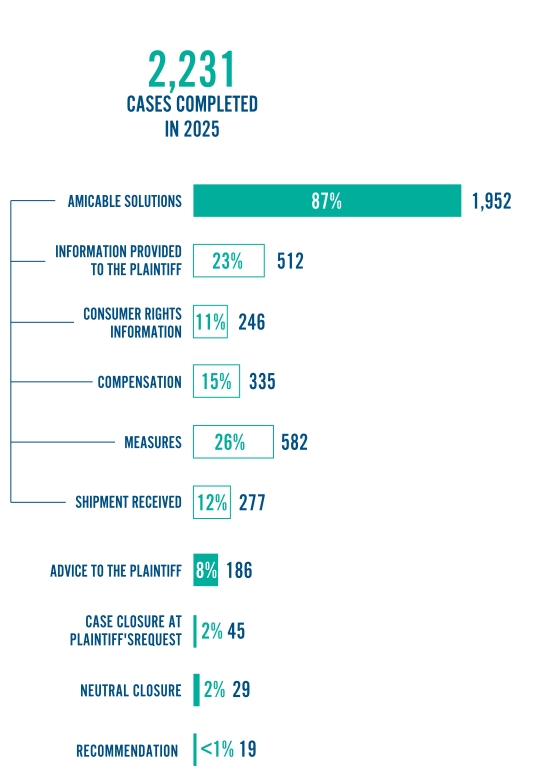
In every admissible case, an investigation is launched and the ombudsman mediates between the parties to reach an amicable solution to the dispute. In the course of 2025, we closed 2,231 disputes. In 87% of the mediations, an amicable solution was reached, in the form of compensation, the recovery of a lost shipment, the taking of appropriate measures or the provision of information to the customer to settle the dispute.
1.952
Amicable solutions
335
Cases closed with compensation
277
The investigation results in the receipt of the shipment.
582
The company takes measures to prevent similar problems in the future.
246
cases in which an amicable solution was reached on the basis of consumer law
512
The customer receives the information that settles the dispute.
→ the customer can assert their rights against a third party.
→ the customer accepts the company's explanation.
335
MEDIATION CASE FILES RESULTED IN COMPENSATION FROM THE COMPANY TO THE PLAINTIFF
Compensation can take various forms:
- compensation for the sender based on the company's contract or general terms and conditions;
- compensation for the recipient based on non-contractual liability;
- commercial compensation (for the sender or recipient) as a result of a customer centric approach, fairness or an error on the part of the company.
OMBUDSMAN FILE
COMPLAINT
A Belgian webshop sends a pullover with insurance to a customer in the Netherlands. 'The parcel has not moved since 2 October... In the meantime, I have already contacted the postal company at least 35 times (via chat and telephone). They keep assuring me that an investigation is underway and that they are working on it. ... Very frustrating. My customer in the Netherlands no longer wants the parcel, so it should be returned to me. At my wits' end, I am contacting you. The parcel contains a pull worth €369.'
SOLUTION
The results of the investigation show that the parcel was lost by the transport company responsible for the last mile in the Netherlands. Liability is determined on the basis of the contractual links: on the one hand between the transport companies themselves, and on the other hand, the webshop is compensated by the transport company for the amount of the loss.
277
MEDIATION CASE HANDLING FILES LED TO THE RECEIPT OF THE SHIPMENT
The most common complaint to ombudsman poste is the disappearance of a parcel. The parcel can no longer be tracked, the postal company declares the parcel untraceable, the parcel is marked as delivered but the recipient has not received it, etc. Delays in the transport and delivery of a parcel also lead to many disputes.
In 277 such cases, the investigation led to the package or registered item being found and delivered to the recipient.
OMBUDSMAN FILE
COMPLAINT
A lady receives an email notification that her parcel has been delivered to her address. When she gets home, she cannot find it. Her husband, who was at home, did not see any delivery person. The lady reports the problem to the seller in the United States and to the parcel company. Both respond that the parcel is listed as delivered in their system and that the matter is therefore resolved for them.
SOLUTION
After the ombudsman investigation was launched, it soon became clear that the GPS data showed that the parcel had been delivered across the street (a busy dual carriageway). The customer enquired at the company across the street and received her parcel with some delay.
582
MEDIATION CASE FILES LED TO MEASURES BEING TAKEN BY THE OPERATOR
Such cases usually concern problems with the delivery of letters, parcels, newspapers and magazines. After investigation, the company takes measures to avoid errors in delivery in the future.
OMBUDSMAN FILE
COMPLAINT
Mr N. has a problem with the delivery of his parcels. They are always taken directly to a collection point without first being offered for delivery to his home. Contact with the carrier has not led to a solution, despite promises of improvement.
SOLUTION
The investigation reveals that the customer's location is not correctly displayed in the company's navigation system. After discussion with the delivery driver, home delivery is once again carried out correctly.
512
OMBUDSCASES LED TO AN AMICABLE SOLUTION BY PROVIDING THE CUSTOMER WITH APPROPRIATE INFORMATION
A shipment usually involves three parties: the sender, the recipient and the postal company. The contractual relationships and obligations between these parties are not always entirely clear. In addition, the postal sector has its own specific legislation at international and national level. An important part of the ombudsman's work is therefore to correctly inform the sender or recipient about their rights, obligations and liabilities.
OMBUDSMAN FILE
COMPLAINT
Mr R. sells a candlestick (C2C) to a private individual in Lille for 240 €. Despite being securely packaged, the candlestick arrives damaged in Lille. The transport company acknowledges the damage during transport and compensates the customer in accordance with CMR legislation with a payment of €97.50. The customer wants €240 back but receives no further response to his questions.
SOLUTION
After investigation, the compensation paid appears to be correct for the shipping method chosen by the customer, without additional insurance. The ombudsman service informs the customer about the different shipping methods available and their associated compensation rates.
248
cases in which an amicable solution was reached on the basis of consumer law
The cases relating to parcels handled by the mediation service mainly concern commercial shipments. Although the seller has various legal obligations towards his customer, we see cases where consumer law is not applied. In such cases, the consumer often needs the results of the postal investigation in order to receive compensation based on consumer law.
OMBUDSMAN FILE
COMPLAINT
Mr L. orders a bicycle battery from a professional seller. He is not at home when it is delivered and his parcel is left outside his door. Upon his return, the plaintiff cannot find the parcel and contacts the seller. The seller refuses to refund the amount because the tracking information indicates that the delivery has been made. Mr L. then turns to the postal service, which refers him to the seller to resolve the dispute.
SOLUTION
The ombudsman service's investigation results in the transport company acknowledging that the parcel was not delivered correctly. The transport company reimburses its customer, the online shop. The online shop in turn reimburses the customer for the purchase price of 480 €.
If an amicable agreement is not reached
If an amicable solution could not be reached, the ombudsman takes a position based on the findings of the investigation. This position results in a recommendation to the company or advice to the customer.
A recommendation to the company confirms to the postal user concerned that the ombudsman service is following its position. The plaintiff has the option of using the recommendation if he initiates legal proceedings against the postal company.
In 2025, ombudsman poste made 19 recommendations.
Four recommendations were followed: two for bpost, one for Mondial Relay and one for Colis Privé.
Fifteen recommendations were addressed to bpost in connection with a parcel that was only scanned once upon delivery by the sender. Bpost did not follow 14 of these recommendations, while one recommendation was partially followed.
What is a recommendation?
A recommendation is an official instrument used by the Ombudsman Service to write a reasoned opinion to the company concerned in cases where mediation is at risk of breaking down, clearly summarising the relevant facts, the applicable legislation and general terms and conditions, and the analysis and opinion of the Ombudsman Service, with a proposal for an amicable settlement.
If the company does not respond within twenty working days with its own reasoned opinion on why it disagrees with the Ombudsman Service, the postal company in question is legally bound by the amicable settlement as proposed by the Ombudsman Service.
« § 3. The Ombudsman Service for the postal sector has the following tasks:
…
4° to issue a recommendation to the companies referred to in § 1 of this article if no amicable settlement can be reached. A copy of the recommendation shall be sent to the plaintiff;
…
§ 6. The company concerned has a period of twenty working days to justify its decision if it does not follow the recommendation referred to in § 3, 4° of this article. The reasoned decision shall be sent to the plaintiff and to the Ombudsman Service.
After the expiry of the period referred to in the previous paragraph, the ombudsman service shall send a reminder to the company concerned. The latter shall have a further period of twenty working days to justify its decision if it does not follow the recommendation referred to in § 3, 4° of this article. The reasoned decision shall be sent to the plaintiff and to the ombudsman service.
By failing to comply with the aforementioned period, the company concerned undertakes to implement the advice with regard to the specific and personal compensation to the plaintiff concerned. »
Article 43ter of the Act of 21 March 1991 on the reform of certain economic companies
Source: https://www.ejustice.just.fgov.be/cgi_loi/change_lg.pl?language=nl&la=N&cn=1991032130&table_name=wet
186
MEDIATION REQUESTS RESULTED IN AN ADVICE TO THE PLAINTIFF
If, after investigating a dispute and analysing the positions of both parties, the ombudsman service finds that the company has not made any mistakes and has acted in accordance with its general terms and conditions and the law, the ombudsman will communicate this in an advice to the customer.
OMBUDSMAN FILE
COMPLAINT
Ms S. was expecting a gift package containing tea bags that had been sent by a friend from the United Kingdom. As it was a gift with a value of less than €45, she was surprised to receive an invoice for customs charges. The postal company refused to cancel the customs clearance charges.
RESULT
After investigation, our service determined that the charges were justified due to a special tax rule relating to tea. In addition to the value limit of €45, a gift between two private individuals may contain a maximum of 100 grams of tea. Tea is an excise good and if this maximum quantity is exceeded, the entire shipment is excluded from the VAT exemption. The mediation service therefore confirmed the validity of the customs charges and informed Ms S. of this.
45
MEDIATION CASES WERE CLOSED WITHOUT REACHING AN AMICABLE SOLUTION
In these cases, no amicable solution was reached. Based on the elements in the file and the results of the investigation, the Ombudsman was unable to take a position in favour of either party. There were conflicting elements, no evidence or simply too little factual information available.
29
CASES WERE DISCONTINUED ON PLAINTIFF'S EXPLICIT REQUEST
In 2025, 29 citizens or companies requested that the mediation be discontinued. The law on qualified entities for out-of-court settlement of consumer disputes states that a consumer may decide to discontinue the mediation at any time during the procedure.
Processing time
94% of cases were closed by December 31st, 2025. The average processing time for a case is 38 working days.
Structural recommendations

Recommendations for 2025
Forced delivery
THE OMBUDSMAN RECOMMENDS THAT THE SECTOR DOES NOT LEAVE PARCELS NEAR THE DELIVERY ADDRESS IN THE ABSENCE OF THE RECIPIENT, UNLESS THE RECIPIENT HAS GIVEN THEIR EXPLICIT AUTHORISATION.
A delivery person who decides, in the absence of the recipient, to leave a parcel: on the driveway, at the front door, in the entrance hall of an apartment building, under the carport, behind a garden gate, between flower boxes, behind or in rubbish bins, with the neighbours, etc. This practice leads to complaints about missing parcels.
In recent years, we have seen that leaving a parcel without the resident's permission has become more widespread throughout the sector. However, most parcel companies prohibit their delivery staff from leaving a parcel without the express permission of the addressee.
bpost does allow its postmen to leave parcels in a 'safe place' in the absence of the recipient: a place around the house that the postman himself considers safe. The postman must take a record this with a photo. The possibility of leaving a parcel in a safe place or with a neighbour is mentioned by bpost in its general and contractual terms and conditions, which are binding on the sender.
Most complaints come from consumers who cannot find their online purchase (or second-hand purchase) when they get home. The big problem for consumers is proving to the seller that they have not received the said product. The tracking states that the parcel has been delivered, and for many senders this is sufficient proof to consider the parcel delivered. The consequences are for the recipient/consumer, who does not get a refund for their purchase. Consumer law and postal legislation are not aligned on this issue.
The ombudsman states that leaving a parcel unattended can only be done with the customer's consent. If there is no consent from the recipient and the parcel has disappeared, it is up to the parcel company to provide proof that the recipient did indeed receive the parcel. In the case of a missing parcel left unattended, the ombudsman assumes that the recipient should be fully compensated for the damage.
Registered mail
THE OMBUDSMAN RECOMMENDS THAT BPOST OPTIMISE THE DELIVERY PROCEDURE OF REGISTERED MAIL.
A registered item differs from other postal products in that it is handed over in person to the person to whom it is addressed or to a person who can present a valid power of attorney to receive a registered item on behalf of a third party or a legal entity.
The procedure for delivering such items therefore requires thorough training and monitoring of postmen and postal clerks: checking the addressee's identity, registering a signature for receipt, redirecting the registered item in the absence of the addressee, returning the receipt card if the sender has opted for this, etc. A recent point of attention: leaving a registered item in the letterbox can only be done with a valid Sign For Me mandate from the addressee.
Right of inspection for the addressee
THE OMBUDSMAN RECOMMENDS THAT THE SECTOR GUARANTEE THE RIGHTS OF THE ADDRESSEE: BY ACCEPTING AND INVESTIGATING THEIR COMPLAINT, PROVIDING THE CUSTOMER WITH CORRECT INFORMATION AND, IN JUSTIFIED CASES, COMPENSATING THEM FOR THEIR LOSS.
The ombudsman service emphasises that the addressee is the first to experience a problem when a shipment is damaged, delayed or does not arrive at all. Contacting the postal company's customer service department to find a solution is a logical reflex. But they cannot turn to them. Most postal companies continue to refer the recipient to the sender. Questions, problems or complaints from the recipient are dismissed without providing a substantive answer or initiating an investigation.
The recipient is referred to the sender of the shipment. According to the postal companies, the sender is their customer, as they paid for the shipment and therefore have a contractual relationship with the company.
This view is contrary to the interpretation of the current Postal Directive, as set out in the recitals.
The Directive expressly states that all users of postal services have the right to contact customer service with a question or complaint. The term 'users of postal services' is defined as both the sender and the recipient of a postal item. The Directive was implemented in the Postal Services Act of 26 January 2018.
The Ombudsman recognises that contractual obligations exist between senders and recipients (e.g. between a webshop and a consumer, with regard to withdrawal rights and refunds or replacements in the event of non-delivery). In our opinion, these obligations should be distinguished from the right of a postal service user to contact the postal company's customer service department for a substantive response. Given the increasing number of parcels sent in the context of online purchases, we also note that consumers need the results of a postal company's investigation in order to be able to enforce their rights vis-à-vis their seller.
Policy advice
THE OMBUDSMAN ADVISES THE AUTHORITIES TO MAKE SURE THAT THE EUROPEAN POSTAL DIRECTIVE REQUIRE THAT EVERY PARCEL CARRIES AN IDENTIFICATION NUMBER, LINKED TO SYSTEMATIC SCANNING AND ONLINE TRACKING AT ALL CRITICAL STAGES OF THE SHIPPING PROCESS.
The aim of the recommendation is to ensure that both senders and recipients can rely on traceable postal services. This is a clear expectation of postal users at a time when an increasing proportion of trade is taking place online. On the one hand, because tracking is a prerequisite for being able to locate and redirect a parcel that deviates from its intended route. The unique reference number can be used as the basis for an investigation. On the other hand, consumers expect compensation if they suffer a loss when their purchase disappears. A traceable label ensures that European citizens/consumers can enforce their rights more effectively.
We receive complaints about untraceable shipments in cross-border e-commerce purchases, where the sender usually chooses the shipping method, while the recipient is the one who suffers damage in the event of non-delivery. The evidence provided by online tracking – and the postal investigation that can be carried out on that basis – helps consumers to assert their rights against distance sellers.
Complaints are also submitted by Belgian senders who send cross-border parcels. Occasional private senders and start-up webshops are often unaware that there are products for which no compensation is provided if the parcel disappears in the postal system.
The fact that bpost, as a universal service provider, only offers traceable shipments in its range of national parcel delivery methods is certainly a good thing.
Follow-up on recommendations
Policy advice on forwarding service
The Ombudsman advises the legislator to require bpost to keep proof of identity of the person requesting the forwarding of correspondence to another address, as well as of any other person whose correspondence is forwarded, with a view to preventing or investigating fraud.
In the 2024 Annual Report, this policy advice was formulated, in consultation with bpost, to protect citizens against identity fraud in the context of the forwarding service.
Pre-contractual information about shipping options: a must
THE OMBUDSMAN RECOMMENDS THAT COMPANIES PROACTIVELY INFORM CUSTOMERS ABOUT THE DIFFERENT SHIPPING OPTIONS AND LIABILITY RULES WHEN PURCHASING A SHIPPING LABEL
Given the limitation of liability, it is very important that consumers are able to make a choice based on the correct information (compensation for different shipping options, possibility of insurance, tracking, delivery against signature, etc.). This applies not only when a customer purchases a shipping label online, but also at physical points of sale.
In the context of universal service, we emphasise that people who occasionally send a parcel or are less digitally savvy use a post office and rely on the information they receive from the counter clerk. The ombudsman service regularly receives complaints from citizens who are surprised by the limited compensation awarded and complain that they were not informed of this when purchasing a shipping label at a post office. In its report of 28 May 2021 on the general terms and conditions in the postal sector, the BRC Unfair Terms Committee also emphasised pre-contractual information in this sector, which is subject to limitations of liability.
The Ombudsman continues to monitor the application of pre-contractual information in post offices and discuss this with bpost.
Focus on the organisation


Our mission
The Ombudsman Service for the Postal Sector is an independent federal government service, created by the Act of 21 March 1991, and since February 2007, responsible for all companies operating in the Belgian postal market.
As an appeals body, the Ombudsman Service has the authority to investigate all complaints from users relating to:
The activities of bpost, with the exception of:
- Complaints for which another independent sectoral dispute committee or independent mediator is competent;
- Complaints concerning products and services offered by bpost under subcontract to third parties.
The postal activities of the companies referred to in §1, 2° and 3° of this article.
Anyone can submit a request for mediation to the ombudsman service: a private individual, a company, an association, an organisation, etc., both the recipient and the sender, provided that the problem relates to a company operating on the Belgian postal market and a complaint has been submitted in advance to the company concerned in accordance with its internal procedure.
The ombudsman service does not have its own legal personality, but is administratively attached to the BIPT, with which a cooperation agreement has been concluded to guarantee the proper functioning and independence of the ombudsman service.
The ombudsman service has a staff of 17 case managers and two ombudsmen.
Funding, budget and results
The ombudsman service is financed by the postal sector. This is done through a formula laid down in law, whereby a postal company pays a contribution, in proportion to the number of admissible complaints per year addressed to its company. Only companies with more than 12 admissible complaints and an annual turnover of more than 500,000 € are required to pay a contribution.
With regard to the budget, Article 45ter §8 of the Act of 21 March 1991 provides as follows: "Each year, the ombudsmen shall submit the draft budget of the Ombudsman Service for the Postal Sector to the Advisory Committee for Postal Services for its opinion. The budget of the Ombudsman Service for the Postal Sector forms a separate part of the budget of the BIPT."
The procedures, obligations and controls applicable to public administrations apply in full to the Ombudsman Service. The same applies to the accounts.
| EVOLUTION OF THE BUDGET | 2025 | 2024 | 2023 |
|---|---|---|---|
| Total budget | € 2,837,590 | € 3,082,425 | € 2,940,575 |
| Staff | € 2,266,340 | € 2,521,825 | € 2,386,075 |
| Operating costs | € 501,250 | € 490,600 | € 484,500 |
| Investments | € 70,000 | € 70,000 | € 70,000 |
| EVOLUTION OF EXPENDITURE | 2025 | 2024 | 2023 |
|---|---|---|---|
| Total expenditure | € 2,320,495 | € 2,354,355 | € 2,447,265 |
| Staff | € 2,044,999 | € 2,132,651 | € 2,208,813 |
| Operating costs | € 275,496 | € 216,602 | € 238,452 |
| Investments | - | € 5,103 | - |
The ombudsman network
The Consumer ombudsman service
Consumers and businesses wishing to resolve a dispute quickly, cheaply and easily can turn to 15 qualified entities, including 10 ombudsman services. Each service acts as an independent and impartial intermediary in its sector.
The vast majority of consumers and businesses go directly to the competent ombudsman service. Consumers and businesses that do not know where to submit their dispute can contact the Consumer Ombudsman Service, which is the final stage of out-of-court dispute resolution in Belgium.
The Consumer Ombudsman Service is the point of contact for consumers and businesses for all questions concerning ADR (Alternative Dispute Resolution or out-of-court dispute resolution). Every request for out-of-court settlement of a consumer dispute is received by the COD and, after thorough analysis, forwarded to the competent qualified entity, such as an ombudsman. Finally, the COD handles all consumer disputes that it cannot refer to any other qualified entity, known as residual disputes.
The Ombudsman Service for the Postal Sector is a member of the management committee of the Consumer Ombudsman Service.
consumentenombudsdienst.be
ombudsman.be
The Ombudsman Service for the Postal Sector is a member of the ombudsman.be network, the Belgian network of ombudsman services. This network brings together 28 ombudsman services of various kinds (federal government, regions, communities, federations, cities and municipalities, economic sectors, etc.). Their main task is to help citizens in an accessible, fair and people-oriented way with problems in their dealings with the institutions and companies concerned.
Through its website, the network guides citizens in finding the right ombudsman and helps them as efficiently as possible by referring them based on their problem. A complaint received by the network is forwarded to the competent service, respecting the principle that the complaint — and not the plaintiff — is transferred. This avoids the citizen having to resubmit their complaint administratively.
